Independent review
A non-authoring model grades every change against its contract and the actual code diff. If review fails three times, the process stops and escalates to a person.

The Factory · Building the AI Factory
Nine stages. Models from three vendors. One human gate. Software moves from request to verified production, but no agent can approve its own work or reach production on its own.
The request is triaged, given a frozen definition of done, built by one agent, and graded by another. A person decides whether it ships. The result is then verified against live production and recorded permanently.
The builder, reviewer, and merger are always separate. The agents come from three different vendors and occupy defined seats, so no model can write a change and then approve its own work.
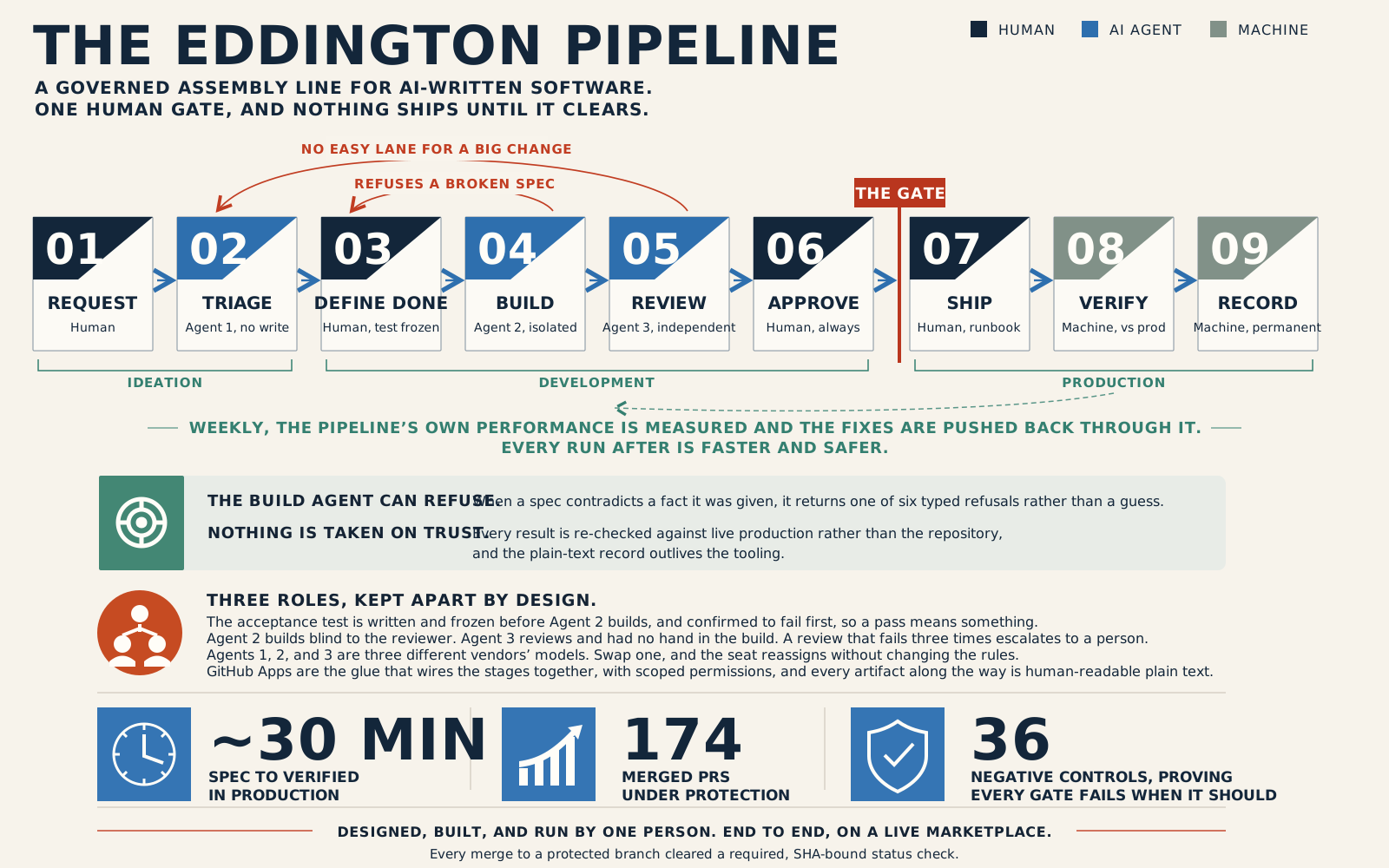
Nine stages across ideation, development, and production, connected through scoped GitHub Apps. Every artifact is retained as human-readable plain text.
Writing code is the part models already do well. Establishing that it is safe to ship is the harder problem, and the one this factory was built to solve.
At every judgment point, the design uses the same pattern: an external source of truth and a grader with no stake in the answer.
A non-authoring model grades every change against its contract and the actual code diff. If review fails three times, the process stops and escalates to a person.
No builder self-report is accepted as evidence. Grades and production verifications read the actual bytes at a named commit through read-only connections.
Branch protection, commit-bound status checks, and scoped permissions ensure no agent can approve, merge, and deploy its own work.
Every decision points to a dated session record, and every deployment binds its approval to the code actually released.
If a specification contradicts a known fact, the build agent returns a typed refusal rather than inventing an answer.
The Factory does not treat a successful deployment as proof the change worked. After release, it reruns the approved acceptance check against live production and records the result against the exact commit that shipped.
The frozen acceptance test is the external truth against which every build is judged.
At Define Done, a planning model writes the acceptance check before the builder sees the work. The check is confirmed to fail against the existing system before Build begins.
Prove the gate can fail.Factory control principle
A failed grade returns the change to Build under a three-attempt limit. It never retries indefinitely and never merges itself. After a human approves the release, the same acceptance check runs against live production.
Every blocking control must be observed rejecting the defect class it claims to catch before a passing result counts as evidence.
One control plants a live-looking credential that the secret scanner must find on every run. It exists because an earlier scanner reported green for weeks after detection had silently stopped working. The lesson became permanent: a control nobody has watched fail is a decoration.
The tools that operate the pipeline are built, graded, and adopted through the same governed lanes as the product code. Each week, performance is measured and improvements are pushed back through it, making subsequent runs faster and safer.
HorseMatch is a live two-sided equine marketplace with published iOS and Android applications, a Laravel and PHP API, and real users.
The Factory has delivered real production changes across six protected repositories while preserving human authority over every release. HorseMatch is the proving ground. The governed pipeline is the transferable system.
The load-bearing lessons, in the order they earned their place.
A control nobody has watched fail is a decoration.
Nothing under review should supply its own judge.
A test written by the builder after the code is not independent evidence.
Governance has to be cheaper than the workaround, or it will be bypassed.
Model-risk discipline applies to the agent building the system as much as to the model being deployed.
A trustworthy system has to be able to tell its owner no.
The Factory demonstrates that agentic delivery can move quickly without surrendering independent review, human authority, or audit-ready evidence.
It began by solving a real production problem and now provides a concrete test of the controls enterprises will need as AI agents take on more consequential work.
The next question is scale: whether the same discipline holds across another product, a larger team, and an enterprise. AIRO packages that discipline into an operating system for enterprise AI adoption.